
SISS meets early careers - 5th May 2026


SISS meets early careers
A seminar series organized by the Italian Society for he History of Science
The Italian Society for the History of Science / Società Italiana di Storia della Scienza (SISS) is pleased to announce a Seminar Series:
SISS Meets Early Careers - 3rd series 2026
The series is conceived as an informal place for early career scholars to discuss their research, present, future and past. Each session focuses on broad themes in the history of science and knowledge, bringing together diverse approaches, methodologies and chronologies. The series is open to international scholars and broad collaboration between disciplinary fields.
All seminars are held online on Zoom: https://unipd.zoom.us/j/86590524102
Information:
5th May 2026, 4.30pm CET
Brenna McWhorter
(University of Virginia)
Title: Star Power: Astral Magic at the Gonzaga Court
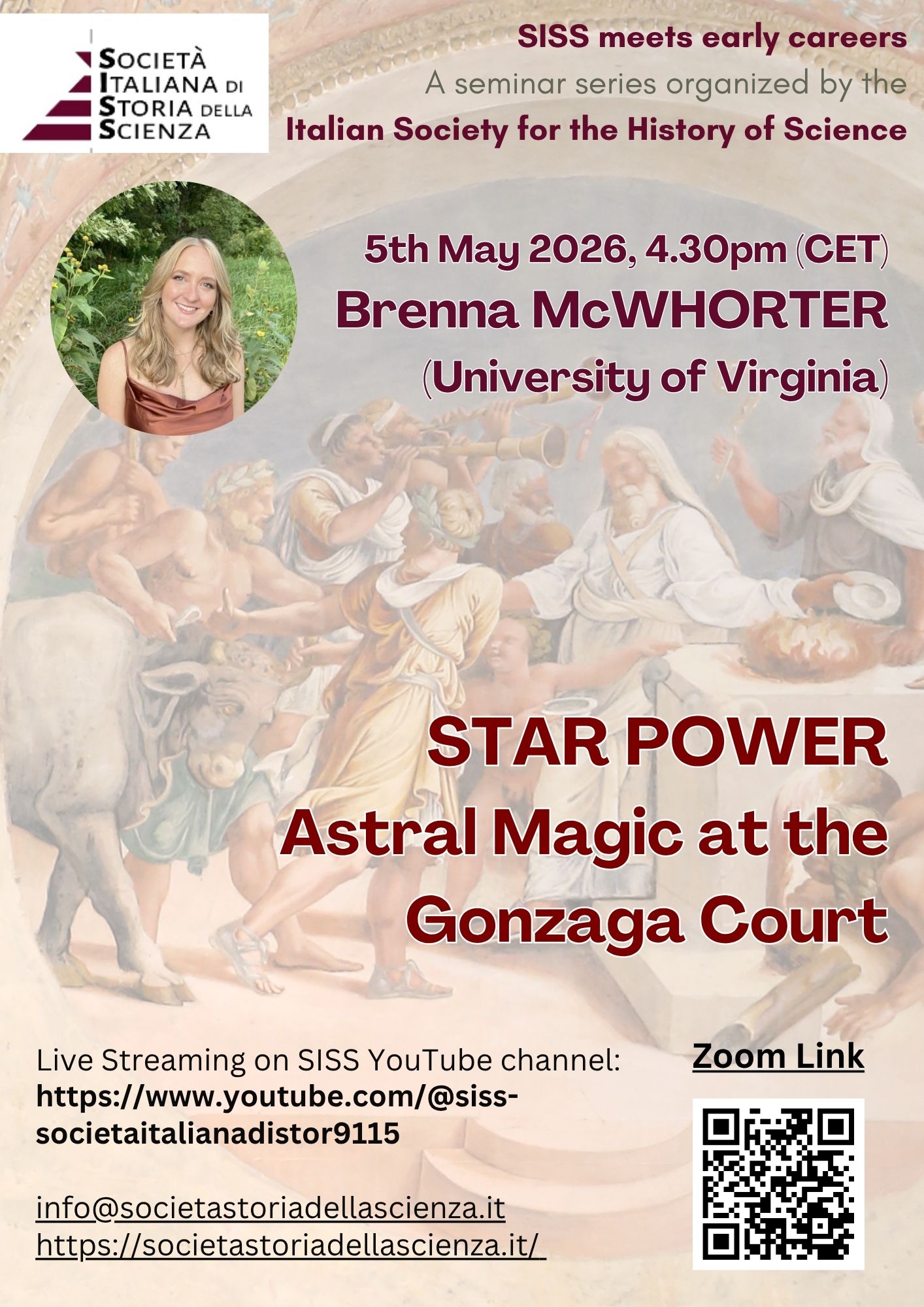
Abstract:
The paper focuses on the presence of astral magic at the influential Gonzaga court in Mantua in the early Cinquecento. The vault decoration of the Camera dei Venti in the Palazzo Te might be considered an important example of the Gonzaga’s astromagical patronage that has gone unremarked. Designed in 1527–28 by Giulio Romano for Federico II Gonzaga, marquis of Mantua, the room’s astrological imagery depicts the Olympian gods, signs of the zodiac, months, winds, and extra-zodiacal constellations. It can be understood not merely as celestial ornament, but as part of a broader courtly investment in astromagical images, evidenced
by Gonzaga patronage reflecting their material engagement with the heavens. During the early modern period, Neoplatonic natural philosophy emphasized the “rays” that emanated from celestial bodies, believed to shape physical matter, individual temperament, and, to greater or lesser degrees, fate. To control fate, one only needed to understand how to harness the properties of these rays, which could be done through celestial images to capture and transfer the qualities of the real stars to a viewer standing below a painted vault. Such forms of celestial image magic, most widely articulated in the Renaissance through the writings of Marsilio Ficino (1489), underlie the program of the Camera dei Venti. By considering this alongside other examples of the Gonzaga’s astromagical patronage, new iconographic interpretations of the Camera dei Venti become available that reframe how a Renaissance audience might have experienced its painted vault.
Reconsidering the Camera dei Venti within this astromagical network offers new considerations for the sustained, courtly investment in astral magic in the early modern period.
Seminars:
- 24th March 2026, Giacomo Simoncelli (Sapienza University of Rome);
- 5th May 2026, Brenna McWhorter (University of Virginia);
- 26th May 2026, Stephanie Reitzig (Columbia University);
- 16th June 2026, José Miguel Ferreira (IHC NOVA FCSH / IN2PAST)