BEGIN:VCALENDAR
VERSION:2.0
PRODID:-//jEvents 2.0 for Joomla//EN
CALSCALE:GREGORIAN
METHOD:PUBLISH
BEGIN:VTIMEZONE
TZID:Europe/Rome
BEGIN:STANDARD
DTSTART:20250227T000000
RDATE:20250330T030000
TZOFFSETFROM:+0200
TZOFFSETTO:+0100
TZNAME:Europe/Rome CET
END:STANDARD
BEGIN:STANDARD
DTSTART:20251026T020000
RDATE:20260329T030000
TZOFFSETFROM:+0200
TZOFFSETTO:+0100
TZNAME:Europe/Rome CET
END:STANDARD
BEGIN:STANDARD
DTSTART:20261025T020000
RDATE:20270328T030000
TZOFFSETFROM:+0200
TZOFFSETTO:+0100
TZNAME:Europe/Rome CET
END:STANDARD
BEGIN:STANDARD
DTSTART:20271031T020000
RDATE:20280326T030000
TZOFFSETFROM:+0200
TZOFFSETTO:+0100
TZNAME:Europe/Rome CET
END:STANDARD
BEGIN:STANDARD
DTSTART:20281029T020000
RDATE:20290325T030000
TZOFFSETFROM:+0200
TZOFFSETTO:+0100
TZNAME:Europe/Rome CET
END:STANDARD
BEGIN:STANDARD
DTSTART:20291028T020000
RDATE:20300331T030000
TZOFFSETFROM:+0200
TZOFFSETTO:+0100
TZNAME:Europe/Rome CET
END:STANDARD
BEGIN:STANDARD
DTSTART:20301027T020000
RDATE:20310330T030000
TZOFFSETFROM:+0200
TZOFFSETTO:+0100
TZNAME:Europe/Rome CET
END:STANDARD
BEGIN:STANDARD
DTSTART:20311026T020000
RDATE:20320328T030000
TZOFFSETFROM:+0200
TZOFFSETTO:+0100
TZNAME:Europe/Rome CET
END:STANDARD
BEGIN:DAYLIGHT
DTSTART:20250330T030000
RDATE:20251026T020000
TZOFFSETFROM:+0100
TZOFFSETTO:+0200
TZNAME:Europe/Rome CEST
END:DAYLIGHT
BEGIN:DAYLIGHT
DTSTART:20260329T030000
RDATE:20261025T020000
TZOFFSETFROM:+0100
TZOFFSETTO:+0200
TZNAME:Europe/Rome CEST
END:DAYLIGHT
BEGIN:DAYLIGHT
DTSTART:20270328T030000
RDATE:20271031T020000
TZOFFSETFROM:+0100
TZOFFSETTO:+0200
TZNAME:Europe/Rome CEST
END:DAYLIGHT
BEGIN:DAYLIGHT
DTSTART:20280326T030000
RDATE:20281029T020000
TZOFFSETFROM:+0100
TZOFFSETTO:+0200
TZNAME:Europe/Rome CEST
END:DAYLIGHT
BEGIN:DAYLIGHT
DTSTART:20290325T030000
RDATE:20291028T020000
TZOFFSETFROM:+0100
TZOFFSETTO:+0200
TZNAME:Europe/Rome CEST
END:DAYLIGHT
BEGIN:DAYLIGHT
DTSTART:20300331T030000
RDATE:20301027T020000
TZOFFSETFROM:+0100
TZOFFSETTO:+0200
TZNAME:Europe/Rome CEST
END:DAYLIGHT
BEGIN:DAYLIGHT
DTSTART:20310330T030000
RDATE:20311026T020000
TZOFFSETFROM:+0100
TZOFFSETTO:+0200
TZNAME:Europe/Rome CEST
END:DAYLIGHT
END:VTIMEZONE
BEGIN:VEVENT
UID:02150d7f13536bbd7e4a8264d673ea70
CATEGORIES:Call for papers
CREATED:20251128T094130
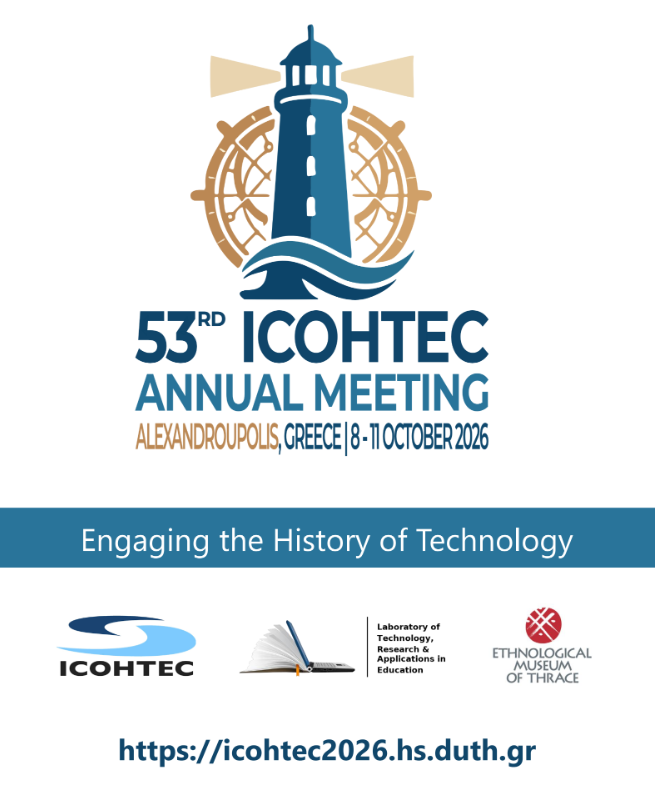
SUMMARY:53rd ICOHTEC Annual Meeting: 1st announcement 
DESCRIPTION:Call for papers for the upcoming ICOHTEC (https://www.icohtec.org/) Annual 
 Meeting, which will be held at the Democritus University of Thrace (https:/
 /duth.gr/en/home-english/) in Greece from 8–11 October 2026, in collaborati
 on with the Laboratory of Technologies, Research &amp; Applications in Educ
 ation (https://resedulab.he.duth.gr/)/ School of Humanities and the Ethnolo
 gical Museum of Thrace (https://emthrace.org/en/) in Alexandroupolis, Greec
 e.\n\nThe theme of this conference, “Engaging the History of Technology”, i
 nvites critical reflections on how history of technology can engage with ev
 olving methodologies, theories and pedagogies, and other branches of histor
 ical study to demonstrate that understanding technologies’ pasts are essent
 ial to navigating contemporary challenges. The conference, therefore, seeks
  contributions across spatial and epistemic boundaries: from the everyday a
 nd local to the geopolitical and planetary; from archival practice to class
 room teaching and public engagement; and from discipline-specific research 
 methods to interdisciplinary collaborations.\nContributors may engage with 
 one or more of the following themes, or even suggest new ways of thinking a
 bout: \n1. The History of Technology between the Local, the Regional, and t
 he Global:\n• Circulation of technologies, expertise, and knowledge across 
 borders\n• Adaptation and appropriation of technologies in different cultur
 al contexts\n• Tensions between globalisation and localisation in technolog
 ical change\n• Regional networks and their role in shaping technological tr
 ajectories\n• Colonial, postcolonial and decolonial dimensions of technolog
 y\n• Networks of maintenance and repair\n\n2. History of Technology, Histor
 iography and Education:\n• Methodological innovations in researching the hi
 story of technology\n• Interdisciplinary approaches and their challenges\n•
  Teaching the history of technology in universities and schools\n• Public e
 ngagement and the communication of technological history\n• The relevance o
 f technology history to contemporary policy debates\n• Digital humanities a
 nd new forms of historical scholarship\n\n3. Intersections between the Hist
 ory of Technology and Other Fields of Historical Study:\n• Technology and s
 ocial history: class, labour, gender, and everyday life\n• Technology and c
 ultural history: representation, identity, and meaning\n• Technology and en
 vironmental history: sustainability, resource use, and ecological change\n•
  Technology and economic history: innovation, industrialisation, and develo
 pment\n• Technology and political history: governance, regulation, and powe
 r\n• Technology and the history of medicine: cultural values, therapeutic p
 ractice, and material conceptions about the human body\n\n4. Special Focus:
  Museums, Material and Intangible Cultural Heritage, and Public Engagement:
  \nGiven our collaboration with the Ethnological Museum of Thrace, we parti
 cularly welcome proposals that engage with material and intangible culture,
  museum practices, and public history. We are interested in innovative sess
 ion formats that:\n• Explore tensions and synergies between academic and mu
 seum approaches to technological history\n• Demonstrate object-based learni
 ng methodologies\n• Address the challenges of communicating technological h
 istory to diverse publics\n• Examine the role of museums in preserving and 
 interpreting technological heritage\n• Study visitor engagements with intan
 gible heritage, particularly those of marginalised and silenced ethno-cultu
 ral communities\n• Critically examine the funding relationships between pri
 vate technological and industrial interests, and museum\n\nWe welcome propo
 sals in the following formats:\nPaper presentations\nIndividual and author 
 teams’ presentations. Please, submit an abstract of up to 350 words.\n\nPan
 el Sessions\nThematically coherent sessions of 3-4 papers. Panel organisers
  should submit a panel abstract (up to 400 words) describing the theme and 
 its significance; after approval the conference committee and the panel org
 anisers will issue a specific call for proposals (individual or author team
 s’ paper abstracts up to 350 words each).\n\nRoundtables\nDiscussion-based 
 sessions with 4-6 participants addressing a specific question or debate. Or
 ganisers should submit a description of the topic and format (up to 350 wor
 ds); names and brief bios of participants (up to 100 words each); key quest
 ions to be addressed.\n\n Graduate Student and Early Career Opportunities\n
 ICOHTEC is committed to supporting emerging scholars. We particularly welco
 me submissions from graduate students and early career researchers. The con
 ference will feature:\n• Visual Lightning Talk Competitions for graduate st
 udents\n• Mentorship opportunities pairing students with established schola
 rs\n• Book development workshops\n\nSubmissions of abstracts through the co
 nference website\nOpening: 15 December 2025\nDeadline: 28 February 2026\n\n
 \nOfficial conference website:  (https://icohtec2026.hs.duth.gr/)https://ic
 ohtec2026. (https://icohtec2026.)hs.duth.gr\nEmail address:  (mailto:icohte
 c2026@gmail.com)Questo indirizzo email è protetto dagli spambots. È necessa
 rio abilitare JavaScript per vederlo.\n
X-ALT-DESC;FMTTYPE=text/html:<div dir="ltr">Call for papers for the upcoming&nbsp;<a href="https://www.i
 cohtec.org/" target="_blank" rel="noopener" data-saferedirecturl="https://w
 ww.google.com/url?q=https://www.icohtec.org/&amp;source=gmail&amp;ust=17644
 05201398000&amp;usg=AOvVaw1iCHiQmYoz0kvbiq_zsBg3">ICOHTEC</a>&nbsp;Annual M
 eeting, which will be held at the<a href="https://duth.gr/en/home-english/"
  target="_blank" rel="noopener" data-saferedirecturl="https://www.google.co
 m/url?q=https://duth.gr/en/home-english/&amp;source=gmail&amp;ust=176440520
 1398000&amp;usg=AOvVaw31UY84-Dy1Y-w8Gi8XPhVQ">&nbsp;Democritus University o
 f Thrace</a>&nbsp;in Greece from<b>&nbsp;8–11 October 2026</b>, in collabor
 ation with the&nbsp;<a href="https://resedulab.he.duth.gr/" target="_blank"
  rel="noopener" data-saferedirecturl="https://www.google.com/url?q=https://
 resedulab.he.duth.gr/&amp;source=gmail&amp;ust=1764405201398000&amp;usg=AOv
 Vaw0CNt7qJEeosXdFTnL0kjq8">Laboratory of Technologies, Research &amp; Appli
 cations in Education</a>/ School of Humanities and the&nbsp;<a href="https:
 //emthrace.org/en/" target="_blank" rel="noopener" data-saferedirecturl="ht
 tps://www.google.com/url?q=https://emthrace.org/en/&amp;source=gmail&amp;us
 t=1764405201398000&amp;usg=AOvVaw24F4HWHj3OE6Cft3ZIixoC">Ethnological Museu
 m of Thrace</a>&nbsp;in&nbsp;<b>Alexandroupolis, Greece</b>.<br /><br />The
  theme of this conference,&nbsp;<b>“Engaging the History of Technology”</b>
 , invites critical reflections on how history of technology can engage with
  evolving methodologies, theories and pedagogies, and other branches of his
 torical study to demonstrate that understanding technologies’ pasts are ess
 ential to navigating contemporary challenges. The conference, therefore, se
 eks contributions across spatial and epistemic boundaries: from the everyda
 y and local to the geopolitical and planetary; from archival practice to cl
 assroom teaching and public engagement; and from discipline-specific resear
 ch methods to interdisciplinary collaborations.</div><div dir="ltr"><br />C
 ontributors may engage with one or more of the following themes, or even su
 ggest new ways of thinking about: <br /><b>1. The History of Technology bet
 ween the Local, the Regional, and the Global:</b><br />• Circulation of tec
 hnologies, expertise, and knowledge across borders<br />• Adaptation and ap
 propriation of technologies in different cultural contexts<br />• Tensions 
 between globalisation and localisation in technological change<br />• Regio
 nal networks and their role in shaping technological trajectories<br />• Co
 lonial, postcolonial and decolonial dimensions of technology<br />• Network
 s of maintenance and repair<br /><br /><b>2. History of Technology, Histori
 ography and Education:</b><br />• Methodological innovations in researching
  the history of technology<br />• Interdisciplinary approaches and their ch
 allenges<br />• Teaching the history of technology in universities and scho
 ols<br />• Public engagement and the communication of technological history
 <br />• The relevance of technology history to contemporary policy debates<
 br />• Digital humanities and new forms of historical scholarship<br /><br 
 /><b>3. Intersections between the History of Technology and Other Fields of
  Historical Study:</b><br />• Technology and social history: class, labour,
  gender, and everyday life<br />• Technology and cultural history: represen
 tation, identity, and meaning<br />• Technology and environmental history: 
 sustainability, resource use, and ecological change<br />• Technology and e
 conomic history: innovation, industrialisation, and development<br />• Tech
 nology and political history: governance, regulation, and power<br />• Tech
 nology and the history of medicine: cultural values, therapeutic practice, 
 and material conceptions about the human body<br /><br /><b>4. Special Focu
 s: Museums, Material and Intangible Cultural Heritage, and Public Engagemen
 t:&nbsp;</b><br />Given our collaboration with the Ethnological Museum of T
 hrace, we particularly welcome proposals that engage with material and inta
 ngible culture, museum practices, and public history. We are interested in 
 innovative session formats that:<br />• Explore tensions and synergies betw
 een academic and museum approaches to technological history<br />• Demonstr
 ate object-based learning methodologies<br />• Address the challenges of co
 mmunicating technological history to diverse publics<br />• Examine the rol
 e of museums in preserving and interpreting technological heritage<br />• S
 tudy visitor engagements with intangible heritage, particularly those of ma
 rginalised and silenced ethno-cultural communities<br />• Critically examin
 e the funding relationships between private technological and industrial in
 terests, and museum<br /><br /><b>We welcome proposals in the following for
 mats:<br /><img src="https://fonts.gstatic.com/s/e/notoemoji/16.0/25aa/72.p
 ng" alt="▪" class="an1" loading="lazy" data-emoji="▪" aria-label="▪" dragga
 ble="draggable" />Paper presentations</b><br />Individual and author teams’
  presentations. Please, submit an abstract of up to 350 words.<br /><b><br 
 /><img src="https://fonts.gstatic.com/s/e/notoemoji/16.0/25aa/72.png" alt="
 ▪" class="an1" loading="lazy" data-emoji="▪" aria-label="▪" draggable="drag
 gable" />Panel Sessions</b><br />Thematically coherent sessions of 3-4 pape
 rs. Panel organisers should submit a panel abstract (up to 400 words) descr
 ibing the theme and its significance; after approval the conference committ
 ee and the panel organisers will issue a specific call for proposals (indiv
 idual or author teams’ paper abstracts up to 350 words each).<br /><br /><b
 ><img src="https://fonts.gstatic.com/s/e/notoemoji/16.0/25aa/72.png" alt="▪
 " class="an1" loading="lazy" data-emoji="▪" aria-label="▪" draggable="dragg
 able" />Roundtables</b><br />Discussion-based sessions with 4-6 participant
 s addressing a specific question or debate. Organisers should submit a desc
 ription of the topic and format (up to 350 words); names and brief bios of 
 participants (up to 100 words each); key questions to be addressed.<br /><b
 ><br /><img src="https://fonts.gstatic.com/s/e/notoemoji/16.0/25aa/72.png" 
 alt="▪" class="an1" loading="lazy" data-emoji="▪" aria-label="▪" draggable=
 "draggable" />&nbsp;Graduate Student and Early Career Opportunities</b><br 
 />ICOHTEC is committed to supporting emerging scholars. We particularly wel
 come submissions from graduate students and early career researchers. The c
 onference will feature:<br />• Visual Lightning Talk Competitions for gradu
 ate students<br />• Mentorship opportunities pairing students with establis
 hed scholars<br />• Book development workshops</div><div dir="ltr"><br /><b
 r /><b>Submissions of abstracts through the conference website<br />Opening
 : 15 December 2025<br />Deadline: <span style="color: #ff0000;">28 February
  2026</span><br /><br /><br />Official conference website:&nbsp;</b><a href
 ="https://icohtec2026.hs.duth.gr/" target="_blank" rel="noopener" data-safe
 redirecturl="https://www.google.com/url?q=https://icohtec2026.hs.duth.gr/&a
 mp;source=gmail&amp;ust=1764405201398000&amp;usg=AOvVaw0NkXmYQnt05N1jz9JHZG
 Jc"></a><a href="https://icohtec2026." target="_blank" rel="noopener">https
 ://icohtec2026.</a><wbr />hs.duth.gr<br /><b>Email address:</b>&nbsp;<a hre
 f="mailto:icohtec2026@gmail.com" target="_blank"></a><joomla-hidden-mail  i
 s-link="1" is-email="1" first="aWNvaHRlYzIwMjY=" last="Z21haWwuY29t" text="
 aWNvaHRlYzIwMjZAZ21haWwuY29t" base="" >Questo indirizzo email è protetto da
 gli spambots. È necessario abilitare JavaScript per vederlo.</joomla-hidden
 -mail></div><p><img src="https://societastoriadellascienza.it/images/soci/7
 3-FABIO_FRISINO/new_82/Screenshot_2025-11-28_093721.png" alt="Screenshot 20
 25 11 28 093721" width="655" height="797" /></p>
DTSTAMP:20260825T161645
DTSTART;TZID=Europe/Rome;VALUE=DATE:20260228
DTEND;TZID=Europe/Rome;VALUE=DATE:20260301
SEQUENCE:0
TRANSP:OPAQUE
END:VEVENT
END:VCALENDAR