BEGIN:VCALENDAR
VERSION:2.0
PRODID:-//jEvents 2.0 for Joomla//EN
CALSCALE:GREGORIAN
METHOD:PUBLISH
BEGIN:VTIMEZONE
TZID:Europe/Rome
BEGIN:STANDARD
DTSTART:20241027T020000
RDATE:20250330T030000
TZOFFSETFROM:+0200
TZOFFSETTO:+0100
TZNAME:Europe/Rome CET
END:STANDARD
BEGIN:STANDARD
DTSTART:20251026T020000
RDATE:20260329T030000
TZOFFSETFROM:+0200
TZOFFSETTO:+0100
TZNAME:Europe/Rome CET
END:STANDARD
BEGIN:STANDARD
DTSTART:20261025T020000
RDATE:20270328T030000
TZOFFSETFROM:+0200
TZOFFSETTO:+0100
TZNAME:Europe/Rome CET
END:STANDARD
BEGIN:STANDARD
DTSTART:20271031T020000
RDATE:20280326T030000
TZOFFSETFROM:+0200
TZOFFSETTO:+0100
TZNAME:Europe/Rome CET
END:STANDARD
BEGIN:STANDARD
DTSTART:20281029T020000
RDATE:20290325T030000
TZOFFSETFROM:+0200
TZOFFSETTO:+0100
TZNAME:Europe/Rome CET
END:STANDARD
BEGIN:STANDARD
DTSTART:20291028T020000
RDATE:20300331T030000
TZOFFSETFROM:+0200
TZOFFSETTO:+0100
TZNAME:Europe/Rome CET
END:STANDARD
BEGIN:STANDARD
DTSTART:20301027T020000
RDATE:20310330T030000
TZOFFSETFROM:+0200
TZOFFSETTO:+0100
TZNAME:Europe/Rome CET
END:STANDARD
BEGIN:STANDARD
DTSTART:20311026T020000
RDATE:20320328T030000
TZOFFSETFROM:+0200
TZOFFSETTO:+0100
TZNAME:Europe/Rome CET
END:STANDARD
BEGIN:DAYLIGHT
DTSTART:20240609T163000
RDATE:20241027T020000
TZOFFSETFROM:+0100
TZOFFSETTO:+0200
TZNAME:Europe/Rome CEST
END:DAYLIGHT
BEGIN:DAYLIGHT
DTSTART:20250330T030000
RDATE:20251026T020000
TZOFFSETFROM:+0100
TZOFFSETTO:+0200
TZNAME:Europe/Rome CEST
END:DAYLIGHT
BEGIN:DAYLIGHT
DTSTART:20260329T030000
RDATE:20261025T020000
TZOFFSETFROM:+0100
TZOFFSETTO:+0200
TZNAME:Europe/Rome CEST
END:DAYLIGHT
BEGIN:DAYLIGHT
DTSTART:20270328T030000
RDATE:20271031T020000
TZOFFSETFROM:+0100
TZOFFSETTO:+0200
TZNAME:Europe/Rome CEST
END:DAYLIGHT
BEGIN:DAYLIGHT
DTSTART:20280326T030000
RDATE:20281029T020000
TZOFFSETFROM:+0100
TZOFFSETTO:+0200
TZNAME:Europe/Rome CEST
END:DAYLIGHT
BEGIN:DAYLIGHT
DTSTART:20290325T030000
RDATE:20291028T020000
TZOFFSETFROM:+0100
TZOFFSETTO:+0200
TZNAME:Europe/Rome CEST
END:DAYLIGHT
BEGIN:DAYLIGHT
DTSTART:20300331T030000
RDATE:20301027T020000
TZOFFSETFROM:+0100
TZOFFSETTO:+0200
TZNAME:Europe/Rome CEST
END:DAYLIGHT
BEGIN:DAYLIGHT
DTSTART:20310330T030000
RDATE:20311026T020000
TZOFFSETFROM:+0100
TZOFFSETTO:+0200
TZNAME:Europe/Rome CEST
END:DAYLIGHT
END:VTIMEZONE
BEGIN:VEVENT
UID:b46cbadc2c28bcac94005e5c780601d9
CATEGORIES:Seminari
CREATED:20250312T153143
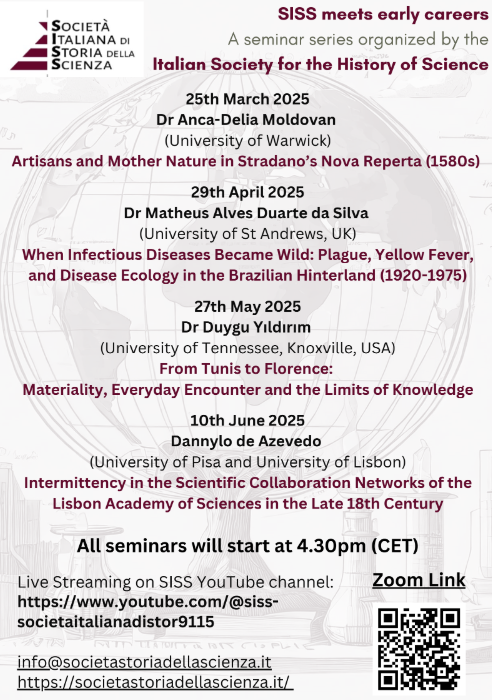
SUMMARY:Intermittency in the scientific collaboration networks of the Lisbon Academy of Sciences in the Late 18th Century by Dannylo de Azevedo (University of Pisa and University of Lisbon)
DESCRIPTION:“SISS meets early careers”\nA seminar series organized by the Italian Socie
ty for the History of Science\n2nd series 2025\n4.30pm CET\n10th June 2025\
nDannylo de Azevedo (University of Pisa and University of Lisbon)\nTitle: I
ntermittency in the scientific collaboration networks of the Lisbon Academy
of Sciences in the Late 18th Century\n\n\nFounded on December 24, 1779, th
e Lisbon Academy of Sciences was established to promote the scientific deve
lopment of Portugal and its empire. Under the patronage of the Portuguese s
tate, the institution fostered intellectual and scientific sociability amon
g intellectuals and statesmen from diverse backgrounds, spanning various Eu
ropean countries and more distant locations across the Portuguese empire. T
o this end, the Academy structured and institutionalized scientific collabo
ration networks as effectively as possible through a membership system. Thi
s system included resident members, primarily based in Lisbon, who actively
participated in the institution’s daily activities, and corresponding memb
ers responsible for communicating with their metropolitan counterparts rega
rding objects and topics of technical or scientific significance. These col
laboration networks, therefore, involved individuals who engaged with the i
nstitutionalization of scientific activity in different ways. In this conte
xt, although the Academy effectively functioned as an important central ins
titutional reference, the dynamics of its collaboration networks were, at v
arious moments, marked by the intermittency of communication or interaction
among the individuals and groups that comprised them.\nDannylo de Azevedo
is a PhD candidate in History at the University of Pisa, Italy, and the Uni
versity of Lisbon, Portugal. His research examines the intellectual product
ion of the Lisbon Academy of Sciences between 1779 and 1822, focusing on it
s political role in shaping economic reform projects for the Portuguese Emp
ire. He holds a BA in History (2014) and an MA in Economic History (2018) f
rom the University of São Paulo, Brazil. His master's research explored the
circulation of agricultural books within the Portuguese Empire in the late
18th century.\n\n
X-ALT-DESC;FMTTYPE=text/html:“SISS meets early careers”
A seminar se
ries organized by the Italian Society for the History of Science
2nd s
eries 2025
4.30pm CET
10th June 2025
Dannylo de Azevedo (Un
iversity of Pisa and University of Lisbon)
Title: Intermittency in the
scientific collaboration networks of the Lisbon Academy of Sciences in the
Late 18th Century
Founded on December 24, 1779, the Lisb
on Academy of Sciences was established to promote the scientific developmen
t of Portugal and its empire. Under the patronage of the Portuguese state,
the institution fostered intellectual and scientific sociability among inte
llectuals and statesmen from diverse backgrounds, spanning various European
countries and more distant locations across the Portuguese empire. To this
end, the Academy structured and institutionalized scientific collaboration
networks as effectively as possible through a membership system. This syst
em included resident members, primarily based in Lisbon, who actively parti
cipated in the institution’s daily activities, and corresponding members re
sponsible for communicating with their metropolitan counterparts regarding
objects and topics of technical or scientific significance. These collabora
tion networks, therefore, involved individuals who engaged with the institu
tionalization of scientific activity in different ways. In this context, al
though the Academy effectively functioned as an important central instituti
onal reference, the dynamics of its collaboration networks were, at various
moments, marked by the intermittency of communication or interaction among
the individuals and groups that comprised them.
Dannylo de Azevedo i
s a PhD candidate in History at the University of Pisa, Italy, and the Univ
ersity of Lisbon, Portugal. His research examines the intellectual producti
on of the Lisbon Academy of Sciences between 1779 and 1822, focusing on its
political role in shaping economic reform projects for the Portuguese Empi
re. He holds a BA in History (2014) and an MA in Economic History (2018) fr
om the University of São Paulo, Brazil. His master's research explored the
circulation of agricultural books within the Portuguese Empire in the late
18th century.
DTSTAMP:20260921T060149
DTSTART;TZID=Europe/Rome:20250610T163000
SEQUENCE:0
TRANSP:OPAQUE
END:VEVENT
END:VCALENDAR