BEGIN:VCALENDAR
VERSION:2.0
PRODID:-//jEvents 2.0 for Joomla//EN
CALSCALE:GREGORIAN
METHOD:PUBLISH
BEGIN:VTIMEZONE
TZID:Europe/Rome
BEGIN:STANDARD
DTSTART:20231029T020000
RDATE:20240331T030000
TZOFFSETFROM:+0200
TZOFFSETTO:+0100
TZNAME:Europe/Rome CET
END:STANDARD
BEGIN:STANDARD
DTSTART:20241027T020000
RDATE:20250330T030000
TZOFFSETFROM:+0200
TZOFFSETTO:+0100
TZNAME:Europe/Rome CET
END:STANDARD
BEGIN:STANDARD
DTSTART:20251026T020000
RDATE:20260329T030000
TZOFFSETFROM:+0200
TZOFFSETTO:+0100
TZNAME:Europe/Rome CET
END:STANDARD
BEGIN:STANDARD
DTSTART:20261025T020000
RDATE:20270328T030000
TZOFFSETFROM:+0200
TZOFFSETTO:+0100
TZNAME:Europe/Rome CET
END:STANDARD
BEGIN:STANDARD
DTSTART:20271031T020000
RDATE:20280326T030000
TZOFFSETFROM:+0200
TZOFFSETTO:+0100
TZNAME:Europe/Rome CET
END:STANDARD
BEGIN:STANDARD
DTSTART:20281029T020000
RDATE:20290325T030000
TZOFFSETFROM:+0200
TZOFFSETTO:+0100
TZNAME:Europe/Rome CET
END:STANDARD
BEGIN:STANDARD
DTSTART:20291028T020000
RDATE:20300331T030000
TZOFFSETFROM:+0200
TZOFFSETTO:+0100
TZNAME:Europe/Rome CET
END:STANDARD
BEGIN:STANDARD
DTSTART:20301027T020000
RDATE:20310330T030000
TZOFFSETFROM:+0200
TZOFFSETTO:+0100
TZNAME:Europe/Rome CET
END:STANDARD
BEGIN:STANDARD
DTSTART:20311026T020000
RDATE:20320328T030000
TZOFFSETFROM:+0200
TZOFFSETTO:+0100
TZNAME:Europe/Rome CET
END:STANDARD
BEGIN:DAYLIGHT
DTSTART:20230517T000000
RDATE:20231029T020000
TZOFFSETFROM:+0100
TZOFFSETTO:+0200
TZNAME:Europe/Rome CEST
END:DAYLIGHT
BEGIN:DAYLIGHT
DTSTART:20240331T030000
RDATE:20241027T020000
TZOFFSETFROM:+0100
TZOFFSETTO:+0200
TZNAME:Europe/Rome CEST
END:DAYLIGHT
BEGIN:DAYLIGHT
DTSTART:20250330T030000
RDATE:20251026T020000
TZOFFSETFROM:+0100
TZOFFSETTO:+0200
TZNAME:Europe/Rome CEST
END:DAYLIGHT
BEGIN:DAYLIGHT
DTSTART:20260329T030000
RDATE:20261025T020000
TZOFFSETFROM:+0100
TZOFFSETTO:+0200
TZNAME:Europe/Rome CEST
END:DAYLIGHT
BEGIN:DAYLIGHT
DTSTART:20270328T030000
RDATE:20271031T020000
TZOFFSETFROM:+0100
TZOFFSETTO:+0200
TZNAME:Europe/Rome CEST
END:DAYLIGHT
BEGIN:DAYLIGHT
DTSTART:20280326T030000
RDATE:20281029T020000
TZOFFSETFROM:+0100
TZOFFSETTO:+0200
TZNAME:Europe/Rome CEST
END:DAYLIGHT
BEGIN:DAYLIGHT
DTSTART:20290325T030000
RDATE:20291028T020000
TZOFFSETFROM:+0100
TZOFFSETTO:+0200
TZNAME:Europe/Rome CEST
END:DAYLIGHT
BEGIN:DAYLIGHT
DTSTART:20300331T030000
RDATE:20301027T020000
TZOFFSETFROM:+0100
TZOFFSETTO:+0200
TZNAME:Europe/Rome CEST
END:DAYLIGHT
BEGIN:DAYLIGHT
DTSTART:20310330T030000
RDATE:20311026T020000
TZOFFSETFROM:+0100
TZOFFSETTO:+0200
TZNAME:Europe/Rome CEST
END:DAYLIGHT
END:VTIMEZONE
BEGIN:VEVENT
UID:d79f685d3c57732b240aff7e5b8d880f
CATEGORIES:Seminari
CREATED:20240506T174805
SUMMARY:SISS Meets Early Careers_Global Knowledge(s)
DESCRIPTION: The Italian Society for the History of Science / Società Italiana di Stori
a della Scienza (SISS) is pleased to announce a new Seminar Series:\nSISS M
eets Early CareersThe series is conceived as an informal place for early ca
reer scholars to discuss their research, present, future and past. Each ses
sion focuses on broad themes in the history of science and knowledge, bring
ing together diverse approaches, methodologies and chronologies. The series
is open to international scholars and broad collaboration between discipli
nary fields.\nAll seminars are held online on Zoom: (https://unipd.zoom.us
/j/85357882609) (https://unipd.zoom.us/j/85357882609)https://unipd.zoom.us/
j/85357882609 (https://unipd.zoom.us/j/85357882609)\nStreaming: (index.php
/it/attivita/eventi-siss/%3Ca%20href=)//www.youtube.com/@siss-societaitalia
nadistor9115>"> (https://www.youtube.com/)https://www.youtube.com/ (h
ttps://www.youtube.com/)@siss-societaitalianadistor9115\nInformation: (mai
lto:info@societastoriadellascienza.it) (mailto:info@societastoriadellascien
za.it)Questo indirizzo email è protetto dagli spambots. È necessario abilit
are JavaScript per vederlo.; (https://societastoriadellascienza.it/) (http
s://societastoriadellascienza.it/)https://societastoriadellascienza.it/ (ht
tps://societastoriadellascienza.it/).\nOrganizer of the first series: Dr La
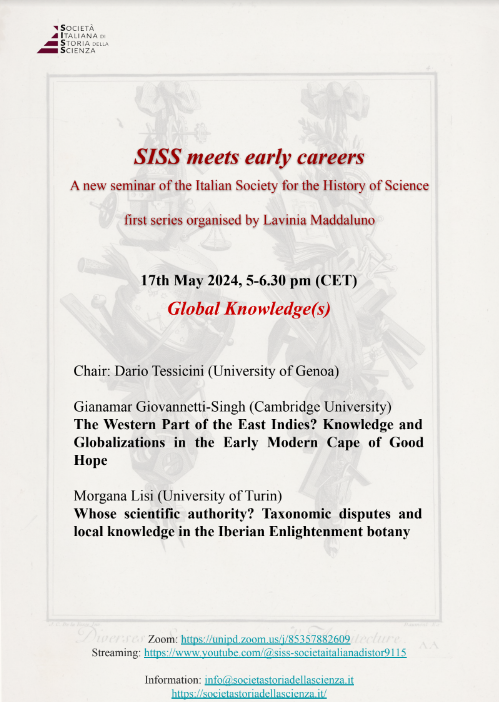
vinia Maddaluno (Ca’ Foscari University of Venice).\nSession 317th May 2024
(5-6.30pm)Global Knowledge(s)\nChair: Dario Tessicini (University of Genova
)\nGianamar Giovannetti-Singh (Cambridge University), The Western Part of t
he East Indies? Knowledge and Globalizations in the Early Modern Cape of Go
od Hope\n\nMorgana Lisi (University of Turin), Whose scientific authority?
Taxonomic disputes and local knowledge in the Iberian Enlightenment botany\
n\nAbstracts and bios\nGianamar Giovannetti-Singh (Cambridge University), T
he Western Part of the East Indies? Knowledge and Globalizations in the Ear
ly Modern Cape of Good Hope\nWhere does southern Africa fit within global h
istories of the sciences? Between the late fifteenth and late nineteenth ce
nturies, almost every traveller sailing between Asia and Europe spent time
at the Cape of Good Hope. Often described as the "Tavern of the Two Seas,"
the early modern Cape was a bustling hub of disparate, interacting cultures
of knowledge. Indigenous Khoekhoen populations, European travellers, Dutch
settlers, and enslaved East Africans, South Asians, and Southeast Asians b
rought diverse cosmologies to the southern tip of Africa, producing new, hy
bridised understandings of natures and humans. In May 1685, an embassy of F
rench Jesuits destined for Siam and China disembarked at the Cape, where th
ey built a temporary astronomical observatory in the Dutch East India Compa
ny's Garden. The travelling missionaries documented their interactions with
the Khoekhoen, translating southern African conceptions of the heavens and
local plants and animals for European readers. The French Jesuits, familia
r with Chinese cultures of knowledge from their fellow missionaries, made s
ense of unfamiliar African knowledges through the lens of Asian sciences. B
y examining the recrafting of Asian knowledges at the Cape Colony, this pap
er explores southern Africa's crucial importance in the early modern global
isation of several natural knowledges. It seeks both to cement southern Afr
ica's crucially important place in the history of the early modern sciences
and explore the ways in which "nature" has been deployed to write out sout
hern African knowledges from global histories of science.\n\nBio: Gianamar
Giovannetti-Singh is the Lumley Research Fellow in History at Magdalene Col
lege and a Leverhulme Trust Early Career Fellow in the Faculty of History a
t the University of Cambridge. His PhD, "Globalising China," completed in 2
023 in the Department of History and Philosophy of Science at Cambridge, ex
amined how the Manchu conquest of China transformed politics and the scienc
es across early modern Eurasia. Gianamar's work has been published and is f
orthcoming in journals including Isis, History Workshop Journal, the Journa
l of the History of Ideas, and the Journal for the History of Knowledge. Gi
anamar has been a Freer Prize Fellow of the Royal Institution, and a visiti
ng fellow at the Max Planck Institute for the History of Science in Berlin
and the Descartes Centre in Utrecht.\n\nMorgana Lisi (University of Turin),
Whose scientific authority? Taxonomic disputes and local knowledge in the
Iberian Enlightenment botany\n\nThe late eighteenth-century Bourbon scienti
fic policies were mainly aimed at exploring the territories of the Spanish
monarchy to define an avant-garde mapping of the profitable resources that
could have been commercialised in medicinal, goods, and luxury markets. Fin
anced by the Crown, the young botanists Hipólito Ruiz and José Pavón explor
ed the nature of the Viceroyalty of Peru and Chile between 1777 and 1788, o
bserving, naming, collecting, and cataloguing endemic species according to
the Linnean system of classification. The majority of the specimens collect
ed during the expedition are now preserved at the Herbarium (MA) of the Roy
al Botanical Garden of Madrid. However, some of the plants determined by Ru
iz and Pavón had already been described by Creole naturalists who previousl
y studied the same territory. By analysing the cases of quillay (Quillaja s
aponaria Molina) and araucaria (Araucaria araucana (Molina) K.Koch), this c
ontribution tries to shed light on – a part of – the epistemic implications
of the scientific expeditions and on the production of knowledge that aros
e from the disputes ensued by the clashes of different scientific authoriti
es that studied the same subject simultaneously. The aim is to enrich conte
mporary historiography with ideas and actors marginally considered by the t
raditional narrative. Indeed, these actors have also participated in constr
ucting Enlightenment botany, creating an Atlantic dialogue between the loca
l and the global dimensions by conveying natural knowledge of distant geogr
aphies into the European cultural horizons.\n\n\nBio: Morgana Lisi is a PhD
Candidate in Global History of Empires at the University of Turin, Italy.
Her research interests include cultural history, the history of science, an
d the history of knowledge in the early modern Iberian world. She authored
various essays on Juan Ignacio Molina's thinking and scientific contributio
n, and she is currently exploring the process of epistemological transforma
tion of Natural History in the eighteenth-century Spanish monarchy, focusin
g on the studies by Creole naturalists in the province of Chile.\n\n
X-ALT-DESC;FMTTYPE=text/html:
The Italian Society for the History of Science / Società
Italiana di Storia della Scienza (SISS) is pleased to announce a new Semina
r Series:
SISS Meets Early Caree
rs
The series is conceived as an informal place for early c
areer scholars to discuss their research, present, future and past. Each se
ssion focuses on broad themes in the history of science and knowledge, brin
ging together diverse approaches, methodologies and chronologies. The serie
s is open to international scholars and broad collaboration between discipl
inary fields.
All seminars are held online on Zoom: https://unipd.zoom.us/j/85357882609
Streaming:&nbs
p;//www.youtube.com/@siss-societaitalianadistor9115>"&g
t;https://www.youtube.com/@siss-socie
taitalianadistor9115
Information: <
a href="mailto:info@societastoriadellascienza.it">Questo indirizzo email è protetto dagli spambots. È necessario abilitare J
avaScript per vederlo.; https://societastoriadellascienza.it/.
Organizer o
f the first series: Dr Lavinia Maddaluno (Ca’ Foscari University of Venice)
.
Session 3
17th May 2024
(5-6
.30pm)
Global Knowledge(s)
Chair: Dario
Tessicini (University of Genova)
Gianamar Giovannetti-Singh (Cambridg
e University), The Western Part of the East Indies? Knowledge and G
lobalizations in the Early Modern Cape of Good Hope
Morgana
Lisi (University of Turin), Whose scientific authority? Taxonomic d
isputes and local knowledge in the Iberian Enlightenment botany
Abstracts and bios
Gianamar Giovannetti-Singh (Cambridge Univ
ersity), The Western Part of the East Indies? Knowledge and Globalizat
ions in the Early Modern Cape of Good Hope
Where does southern Africa
fit within global histories of the sciences? Between the late fifteenth an
d late nineteenth centuries, almost every traveller sailing between Asia an
d Europe spent time at the Cape of Good Hope. Often described as the "Taver
n of the Two Seas," the early modern Cape was a bustling hub of disparate,
interacting cultures of knowledge. Indigenous Khoekhoen populations, Europe
an travellers, Dutch settlers, and enslaved East Africans, South Asians, an
d Southeast Asians brought diverse cosmologies to the southern tip of Afric
a, producing new, hybridised understandings of natures and humans. In May 1
685, an embassy of French Jesuits destined for Siam and China disembarked a
t the Cape, where they built a temporary astronomical observatory in the Du
tch East India Company's Garden. The travelling missionaries documented the
ir interactions with the Khoekhoen, translating southern African conception
s of the heavens and local plants and animals for European readers. The Fre
nch Jesuits, familiar with Chinese cultures of knowledge from their fellow
missionaries, made sense of unfamiliar African knowledges through the lens
of Asian sciences. By examining the recrafting of Asian knowledges at the C
ape Colony, this paper explores southern Africa's crucial importance in the
early modern globalisation of several natural knowledges. It seeks both to
cement southern Africa's crucially important place in the history of the e
arly modern sciences and explore the ways in which "nature" has been deploy
ed to write out southern African knowledges from global histories of scienc
e.
Bio: Gianamar Giovannetti-Singh is the Lumley Research Fello
w in History at Magdalene College and a Leverhulme Trust Early Career Fello
w in the Faculty of History at the University of Cambridge. His PhD, "Globa
lising China," completed in 2023 in the Department of History and Philosoph
y of Science at Cambridge, examined how the Manchu conquest of China transf
ormed politics and the sciences across early modern Eurasia. Gianamar's wor
k has been published and is forthcoming in journals including Isis, History
Workshop Journal, the Journal of the History of Ideas, and the Journal for
the History of Knowledge. Gianamar has been a Freer Prize Fellow of the Ro
yal Institution, and a visiting fellow at the Max Planck Institute for the
History of Science in Berlin and the Descartes Centre in Utrecht.
Morgana Lisi (University of Turin), Whose scientific authority? Tax
onomic disputes and local knowledge in the Iberian Enlightenment botany
The late eighteenth-century Bourbon scientific policies were mainly
aimed at exploring the territories of the Spanish monarchy to define an av
ant-garde mapping of the profitable resources that could have been commerci
alised in medicinal, goods, and luxury markets. Financed by the Crown, the
young botanists Hipólito Ruiz and José Pavón explored the nature of the Vic
eroyalty of Peru and Chile between 1777 and 1788, observing, naming, collec
ting, and cataloguing endemic species according to the Linnean system of cl
assification. The majority of the specimens collected during the expedition
are now preserved at the Herbarium (MA) of the Royal Botanical Garden of M
adrid. However, some of the plants determined by Ruiz and Pavón had already
been described by Creole naturalists who previously studied the same terri
tory. By analysing the cases of quillay (Quillaja saponaria Molina) and ara
ucaria (Araucaria araucana (Molina) K.Koch), this contribution tries to she
d light on – a part of – the epistemic implications of the scientific exped
itions and on the production of knowledge that arose from the disputes ensu
ed by the clashes of different scientific authorities that studied the same
subject simultaneously. The aim is to enrich contemporary historiography w
ith ideas and actors marginally considered by the traditional narrative. In
deed, these actors have also participated in constructing Enlightenment bot
any, creating an Atlantic dialogue between the local and the global dimensi
ons by conveying natural knowledge of distant geographies into the European
cultural horizons.
Bio: Morgana Lisi is a PhD Candidate
in Global History of Empires at the University of Turin, Italy. Her researc
h interests include cultural history, the history of science, and the histo
ry of knowledge in the early modern Iberian world. She authored various ess
ays on Juan Ignacio Molina's thinking and scientific contribution, and she
is currently exploring the process of epistemological transformation of Nat
ural History in the eighteenth-century Spanish monarchy, focusing on the st
udies by Creole naturalists in the province of Chile.
DTSTAMP:20260415T003921
DTSTART;TZID=Europe/Rome;VALUE=DATE:20240517
DTEND;TZID=Europe/Rome;VALUE=DATE:20240518
SEQUENCE:0
TRANSP:OPAQUE
END:VEVENT
END:VCALENDAR